
I love soccer.
I love United.
There is only one United.
I love the Premiership.
And I love Major League Soccer.
I mean that sincerely. I really do.
Those jokes, about MLS goals being “touchdowns” and MLS fans not speaking English are old, tired—and inapplicable. MLS matches drew on average 17,000 fans in 2010, a number that will increase substantially this season because of new facilities and perpetually-sold out expansion teams in Vancouver and Portland. The enthusiasm of those Pacific Northwest MLS crowds is incredible—35,000 a game, all in colors, singing, chanting and waving scarves. Traveling en masse to away games. Those games look and sound like Premier League or Bundesliga matches, except for the accent.
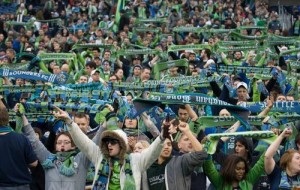 And remember—this is all happening in two cities where the NBA failed (Seattle and Vancouver).
MLS TV ratings are steady, if not overwhelming, despite being filler programming on ESPN2 on the worst night of television: Fridays. (Imagine how much better it could be if ESPN put more of its marketing machine behind the league.) Yet it feels like there’s a stigma against MLS: You have to have a European team as your favorite to be considered a “real” soccer fan.
Which frankly is (expletive deleted). We as American soccer fans should be humiliated.
For decades, in the pre-Internet era, we were starved for more than the skimpy (at best) coverage of European and Latin American leagues. Our lack of knowledge, stemming from no domestic league, was severe.
But we endured. We grew to love the game despite the traditional powers thumbing their noses at an “American soccer fan.” The 1994 World Cup on American soil converted many of us, including me.
And now, when we have a viable, entertaining domestic league with compelling, American superstar players—we meekly re-colonialize our soccer passions.
Why can’t someone be accepted as a genuinely knowledgeable soccer fan—and have MLS be the league he follows? When someone asks you who your favorite soccer team is, you should say with pride: “DC United!” or “LA Galaxy!” or whatever MLS team is your favorite. And if the person starts to snicker at that response, you should say, uhm, something that rhymes with “duck shoe.”
We should be proud of our league. MLS has been a godsend to us American soccer fans by bringing the game home. Our steadily-improving national team is now almost exclusively trained by MLS clubs, though stars may parlay national team success into more lucrative stints in Europe. I’d argue that the quality of play in the MLS would make it the fifth or sixth best league in Europe, top-to-bottom. Sure, England, Spain, Germany and Italy are far better, but I’d argue MLS is close in quality to the French Ligue 1. None of the other European leagues come close. The leagues in Scotland, Portugal, Holland and Turkey are too top heavy; Russian teams benefit from the weather too much.
And we are attracting talent, players that want to come to play here not because of the paycheck, but because of the quality of play. Say what you want about David Beckham coming here at the “end” of his career—Los Angeles revived his career in less than two years, with no less a suitor than AC Milan trying to get him back to Europe afterward. Thierry Henry left Barcelona for New York with plenty of miles left; surely any number of top-flight European teams could have signed him for more than what New York offered.
 We at Perfecting the Upset are as much to blame for this neo-colonialization as anyone else: If you look at our Allegiances, you’ll notice that under soccer, there are no MLS teams represented. [Ed: Prior to this article, there were two MLS teams in the “Additional Allegiances” column, however.] Yes, I know that next to my name is a Manchester United logo—and proudly does it reside there. But I was a United fan before MLS was born; World Cup 1994 made me a soccer fan, then my RSN made me a United fan in the same year by showing them every week until MLS started. Plus, I lived in England for most of my career, where my love for United was integrated with access to Old Trafford.
But I must confess that when I joined Perfecting the Upset, I didn’t even ask our esteemed editor Rahat to put a DC United logo on my allegiances.
(In fairness, part of the reason was that I didn’t want the extra workload. But in a way, that proves my point, too.)
It’s time for us American soccer fans to be proud of our league. We should proudly say that we watch MLS, and that we support our MLS clubs wholeheartedly.
I’ll go first: Please add DC United to my Allegiances.
There is are only one two United(s).
[Ed: MLS fans are also encouraged to check out Bradley Freedman’s “That Sounds a Bit Dodgy” on MLS importing announcers.]
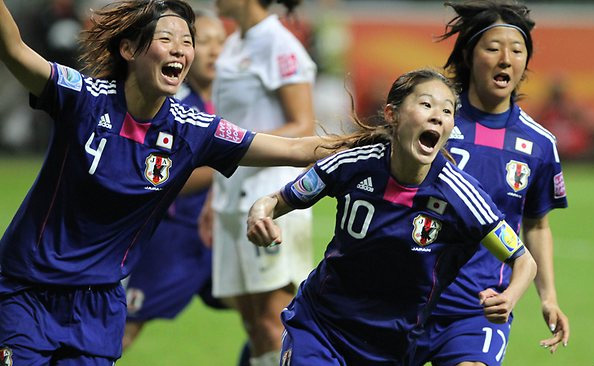 Going into the game, the sentimental value on Japan’s part was well publicized and documented due to the tragedy of the March 11th earthquake and tsunami and the subsequent nuclear disaster in northern Japan. Many of those affected by the calamity are still living in shelters, and in a nation like Japan with its homogeneous society, the tragedy has truly united the country. Men and women. Young and old. Soccer fans and baseball fans. For this reason, and not because they were such heavy underdogs, Japan was easily the sentimental favorite for anyone outside of the U.S.
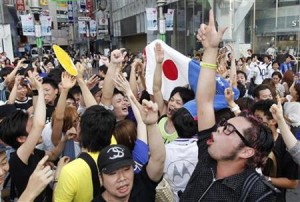 Whether it was sheer luck or divine intervention, it was yet another reminder of the power of sports and its healing power. It didn’t matter that I wasn’t directly affected by the tragedy in Japan. But knowing that my own father, who never sacrifices sleep in order to catch a game on television, woke up at 3:30am Japan time on a Monday to watch this game, I know how much this game meant to him, how much this game inspired him and how much he wanted to be inspired by this game. There is no doubt there were more cheers and tears at dawn across the country on Monday than any other moment in its sports history. Consider what the Saints winning the Super Bowl meant for New Orleans, even five years after Katrina. Now, make that an entire nation and only four months after a tragedy of much bigger magnitude. The degree to which this victory has both inspired and healed the country cannot be stated in mere words.
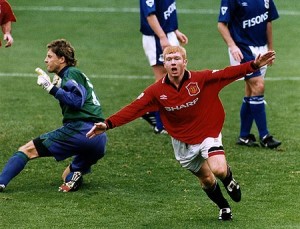 A couple of decades, 676 United first-team appearances and 150 goals later, United’s trainers are still wondering about that growth spurt.
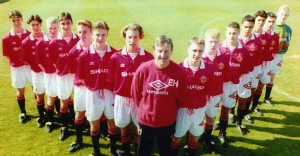 How many teams passed on a little fellow from Mexico who ended up stealing the starting striker’s job—from the guy who led the Premiership in goals, Dimitar Berbatov?
 10. Tampa Bay Buccaneers 48 – Oakland Raiders 21 (Super Bowl XXXVII) » At age 37, Rich Gannon threw for 4,689 yards, won the league MVP and took the Raiders to their first Super Bowl since 1983. The oddsmakers favored their top-rated offense by 4 against Jon Gruden’s top-rated defense, but by the time the third quarter ended, it was obvious that defense did, in fact, win championships. Gruden had gotten revenge against his previous team, and the Al Davis affliction in sunny California continued to persist.
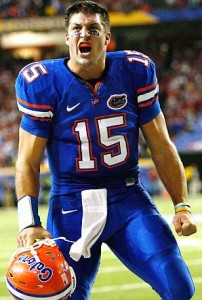 2007 BCS National Championship Game) » Troy Smith, Ted Ginn and Anthony Gonzalez made the Buckeyes look invincible throughout the season (which included a 24-7 dismantling of defending champions from the University of Texas). Aside from a late game comeback by rival Michigan, Ohio State was never in danger of losing a game. This was supposed to be one of the most lopsided deciding bowl games ever. But Chris Leak, Percy Harvin and some fellow named Tim Tebow had other ideas. After the Buckeyes returned the initial kickoff, Harvin matched—and it was a cakewalk for the remainder. It was lopsided, alright, just on the other side.
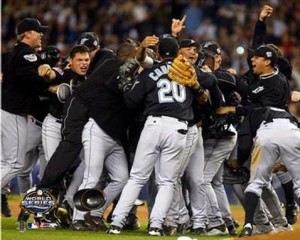 8. Florida Marlins 4 – New York Yankees 2 (2003 World Series) » Money doesn’t always make you happy, and money definitely can’t buy you championships. The Marlins shocked the Yankees (and their $110 million difference in payroll) by riding Josh Beckett to the glory land for the second time in seven years. Along the way, though, they had some extra help from a Cubs fan whose memorabilia-hogging instincts kept the grand prize away for his cursed team.
 7. Greece 1 – Portugal 0 (Euro 2004) » Greece’s improbable run at Euro 2004 was capped with a second defeat of Luiz Felipe Scolari’s Portuguese squad, headlined by Luis Figo and Cristiano Ronaldo, who failed to avenge their opening day loss. Along the way, they also beat France and England. It’s possible to pad this further, but seriously, there shouldn’t be any other data necessary: Greece won Euro 2004 by defeating three powerhouses four times total. That’s the math, and that’s pretty amazing.
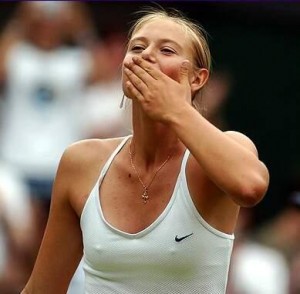 6. Maria Sharapova (6-1, 6-4) over Serena Williams (2004 Wimbledon) » Out of nowhere, 13th seeded, 17-year-old Sharapova beats two-time defending champion and #1 seed Williams in straight sets. This was a passing of the torch, of sorts, not unlike Federer beating Sampras in 2001. Of course, Serena continued her dominance for a while longer, but she’ll never forget the spark she provided to Sharapova’s career at Centre Court.
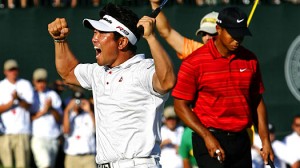 5. Y.E. Yang (-8) over Tiger Woods (-5) (2009 PGA Championship) » Golf isn’t a head-to-head sport, but when you take into effect that Yang and Woods were paired up for the final round at the Hazeltine National Golf Club, you can imagine how intense it must have been throughout the day. Tiger entered the day with a 2 shot lead before ending the day +3, in the process witnessing the first Asian-born player to win a major on the PGA tour. This was all the more impressive as Yang didn’t start playing golf until age 19. The maturing prodigy was defeated by the budding late-bloomer.
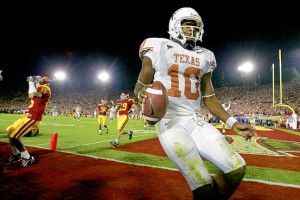 4. Texas 41 – USC 38 (2006 Rose Bowl/BCS National Championship Game) » Matt Leinart this. Reggie Bush that. For all the hype the media loves to generate, there’s probably no doubt amongst college football fanatics that this Trojans team was one of the greatest to ever play. But there was one man who, frankly, didn’t give a damn: Vince Young. He had put in the single greatest individual performance I’ve ever witnessed by the time he crossed into the endzone on 4th and 2. While the awe and magic of a game like this may never again be repeated, Young’s lesson in media-founded histrionics will always be remembered.
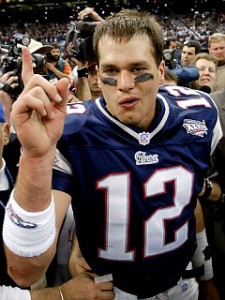 3. Patriots 20 – Rams 17 (Super Bowl XXXVI) » September 11 made New York City a solemn place to live. But for some reason, it felt as if supporting these mediocre “Patriots” would make us all happier. So, we did. Against “the Greatest Show on Turf.” Little did we know that we’d witness the genesis of one of the most hated dynasties in sports history, and that of a man who would end up marrying the world’s highest-paid supermodel and have hair softer than Justin Bieber.
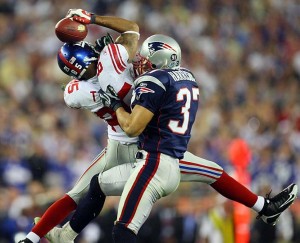 2. Giants 17 – Patriots 14 (Super Bowl XLII) » 18-1.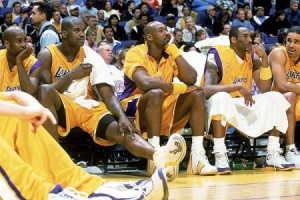
 Over the 4th of July weekend, Portland Timbers rookie midfielder Darlington Nagbe struck one of the goals of the season against Sporting Kansas City. After Nagbe’s fellow midfielder Jack Jewsbury served up a free kick which was punched away by Kansas City goalkeeper Jimmy Nielsen, the ball traveled directly to Nagbe’s right foot. He juggled the ball once, juggled it again and then struck a devastating shot into the top left corner of the net from outside the box. Thankfully for me, it was Portland’s only goal of the night. My Sporting side won a 2-1 victory on the road, while I got the benefit of watching an enjoyable but harmless goal.
 All the same, I can’t dismiss the possibility that the prevalence of Brits is based as much on branding as it is broadcasting. In American culture, the English accent serves as a shorthand in and of itself. The clearest use of this shorthand is Hollywood’s mandatory accent rule of ancient Rome, which stipulates that anyone portraying a Roman must speak in an English accent. This doesn’t mean just hiring English actors. It means that non-English actors must fake an English accent. My personal favorite iteration of this rule occurred in Gladiator, when Russell Crowe (an Australian actor) used an English accent (to speak what historically would have been Latin) in order to portray Maximus Decimus Meridius (a Roman General), a character who the film tells us is actually from Spain.
 For soccer in America, the shorthand of an English (or Irish or Scottish) accent is also clear: Guys with accents know a lot about soccer. And in a country where Cheryl Cole may have been fired by American Idol for her Geordie accent, soccer fans make up one of the few groups who are happy to hear an English accent because of the credibility it conveys. Yes, some of those fans are ignorant snobs who just think the accent “sounds better.” But most simply want to hear games called by people who understand the sport.
 Then, in 2004, I began dating a man who was an ardent Chicago Bears fan. At the beginning of our relationship, it was easy to avoid the games: Adam would be busy on Sunday afternoons, and I’d find something else to do. Football gave me an excuse to have boozy brunches with my ladies. (Though, come to think of it, I probably didn’t need an excuse.) Once we began cohabiting, though, the NFL was much harder to avoid. Initially, we struck a bargain: If I received physical attention in the form of cuddling, I’d watch the games with him. Then the bargain extended to the bar: I’d only come if at least one of my beers was purchased for me and there were wings. Inadvertently, I started learning about the game. At the beginning, I would make up meanings for the call gestures: holding wasn’t holding, it was fisting; that’s not a false start, but rather a sign for the bossa nova (time for a dance break)! The discovery of a new favorite sound made the game even more entertaining: When the rival team attempted a field goal and missed by hitting the posts, the resounding klongggggggg was pure pleasure. Eventually, I did actually accumulate some knowledge, though I’m still nowhere near the level of my male friends who make the calls before the referees do.
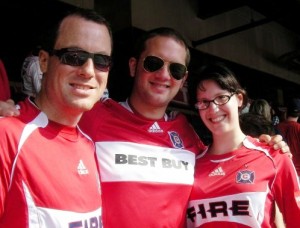
 My path to being interested in sports on any level hit each of these marks. My good friend, Danny, worked for a time on the Major League Soccer website. That, combined with a trip to Adam’s Chicago family, gave the boys a perfect opportunity to introduce me to soccer. (I still think it should be called football, as it is everywhere else in the world and is far more accurate.) As I said before, what I knew of soccer extended to the tips of my braids, but they were committed to changing that. And what better way than to take me to a live game? Not just any live game, though: The opening of Chicagoland area’s Toyota Park in June 2006. When it comes to sports, live games are good, opening days are better and grand openings are best—talk about fanfare! During the game they gave me insights and explanations on how the game was played (much the same way they would on Sunday afternoons at football bars). Our seats were not the best in the arena, but from where we were sitting I could see many of the players and quickly developed a crush on Chicago Fire’s lanky