
Baseball and I, we met at Parker Field in Richmond, Virginia in September of ’83. It was a hot, humid night. A thunderstorm loomed in the west, just above the stadium lights.
Alright, most of that isn’t true. I do know that we met at Parker Field, but I have no idea when it was. I don’t even remember Parker Field. It was torn down in 1984 when I was 6, and I’m not that good at remembering things anyhow. Parker Field was the home of the Richmond Braves, Atlanta’s top farm team. Its replacement, The Diamond, opened in 1985 and is still there today. The R-Braves are not.
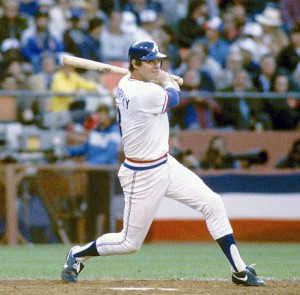 Since Richmond was the final stop for kids on their way to Atlanta, I saw some great players: Glavine in ’87, Smoltz in ’88, Justice in ’89, Chipper in ’93. I’d later see these same kids on TBS every night. It never really seemed like I had a choice: The Atlanta Braves became my favorite team. By the time I’d moved on from tee ball, I had Dale Murphy posters plastered on my wall. I was mimicking Ozzie Virgil’s catching stance. I was convinced Zane Smith was the best pitcher ever. Remember, though, the Braves sucked for most of the 80s. They were horrible. Really, truly horrible. My friend Jason always made fun of the Braves. And he was a freaking Blue Jays fan.
And then ’91 happened. That’s when baseball and I really hit it off. That’s when we took our relationship to the next level.
(To this day, I hate Kent Hrbek. I still check and see if the Giants or Reds lost, even though it’s been almost 20 years since they were in the NL West together. I’d put Mark Lemke in the Hall of Fame. I think Terry Pendleton deserved that MVP.)
Baseball and I spent a lot of time together in those days. Baseball cards provided me the first opportunity to refine my obsessive organizational skills. I watched Baseball Tonight religiously. Every year in early July, I’d plan out All-Star Game night: The right TV angle, the best position on the couch, dinner, the dessert. I could tell you every team’s opening day lineup. I created each All-Star team in Baseball Stars (SHEFLD of the ‘92 National League team was an absolute monster). I’d watch the Cubs on WGN in the afternoon and then the Braves at night on TBS.
But somewhere along the line, at some point in our relationship, things began to change.
It had nothing to do with The Strike. Strikes happen. It had nothing to do with The Steroids. I would have probably done steroids if I played pro baseball. And it had nothing to do with The All-Star Game Determines the Home Team in the World Series. Oh, I know it’s really stupid, but it’s a small blip on the radar. None of those really pushed baseball and I apart.
There were some little things I started to notice, little pet peeves that I thought our love could overcome. At times, ESPN’s coverage of baseball (everything, really) stumbled into yellow journalism. Joe Morgan, Joe Buck and Tim McCarver made watching baseball almost unbearable. The lack of any sort of competitive balance went from annoying to bothersome to deplorable in a matter of years. The Hall of Fame voting. TBS dropping regular coverage of the Braves. I was sure we could weather those storms.
See, I never wanted to admit that I saw the end coming. But my eyes began wandering a bit. I mean, have you seen hockey in HD? I began thinking about others more, thinking about spending more time with football. But I always came back to baseball. This distance between us, it grew in the tiniest of increments, and then one day, I woke up and those little increments had become one giant gulf.
I didn’t seem to know baseball anymore. I couldn’t tell you many opening day lineups. I didn’t know where some free agents had gone. (Jeff Francoeur is on the Royals now? And he was on the Rangers last year?) I can’t tell you the Braves’ 25-man roster right now. I’ve even skipped World Series games. I admit there were World Series games where I didn’t see a single pitch. I saw my friends spending more and more time with baseball and began to feel guilty (yes, I’m talking about you, Wells).
And there was that day, the day when I learned something about baseball that I couldn’t fully live with. On the surface, it didn’t seem like a big deal. But it felt like a big deal: That seedy underbelly of your family-friendly, hometown Minor League Baseball. The way small cities and communities are cowed into giving up the farm for a team that was once the pride of another community. The way these small baseball teams could hold towns hostage. They tell me that, after all, baseball is a business. But that doesn’t really make it any less ugly.
Remember Richmond, where baseball and I met? Allow me to digress. Those very same R-Braves, they moved to Richmond in 1966, the same year the big league Braves moved from Milwaukee to Atlanta. For the next 43 seasons, the R-Braves were Atlanta’s top minor league team. Freaking Dusty Baker played for the R-Braves, that’s how long they’d been around.
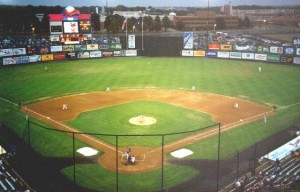 The R-Braves were owned by their parent club in Atlanta. They’d seen The Diamond and they knew it was a pit. A giant, sterile, concrete pit. It was old and dated before the first pitch. They came to town, and they told the Richmond, “We want a new stadium. Richmond should build us a new stadium.” (Not an exact quote.)
The “…or else” is always understood. When minor league team owners get antsy for a new stadium, they make a trip down to your City Hall, schedule a couple of lunch meetings with your Elected Officials. There is always another city who will build a state-of-the-art, shiny new stadium. And the Richmond VIPs made the decision (or non-decision) to take some time and explore their options. In the end, though, the R-Braves became the Gwinnett Braves after the 2008 season. Go find Gwinnett on a map.
(Postscript: A year later, Richmond got an Eastern League franchise affiliated with… wait for it… the San Francisco Giants.)
Richmonders had been going to R-Braves games for 43 years. LBJ was still President. Richmond was a stalwart of the International League, a five-time champion. But Gwinnett County was willing to put their taxpayers on the hook for a stadium that won’t be paid off until 2038. The taxpayers pay for the facility and its maintenance, the team keeps ticket and concessions revenue.
It’s a good business model for the team. It sucks for everyone else. Head up north and ask Edmonton about Nolan Ryan moving the city’s team to Round Rock, Texas. Ask Ottawa about the Lynx. Next year, ask Yakima, Washington and Kinston, North Carolina. Hell, go ask the fine people of Portland, Oregon: They’ve made getting screwed by baseball franchises into an art form.
I’ll paraphrase Henry Hill from Goodfellas for the kids: Screw you, pay me.
So, what does all of this have to do with me and baseball? We all grow up and with age comes a little perspective. A reshuffling of priorities. Perhaps a little touch of cynicism. I wasn’t too old to love baseball, I just didn’t love it the same way. I could no longer buy into the idea that baseball should be as loyal to its fans as its fans are to it. The fans always lose that fight. And that’s when baseball and I went down to the courthouse and filed. Irreconcilable differences.
My baseball cards, they’re in a box in the basement. I don’t get (that) mad anymore when I think about how Dale Murphy isn’t in the Hall of Fame. I own a Minnesota Twins t-shirt. And I’ve been known to wear it.
Some days I do miss what baseball and I had. And don’t misunderstand me, baseball and I still talk. Some nights the wife and the kid, we all get together and spend some time with baseball, watching the Braves when they’re on. We watch Dan Uggla ground into double plays and Derek Lowe throw his 88 mph fastball and I think back to the Braves of the 1980s. I follow Dale Murphy’s Twitter feed. I’m counting down the days until I can play catch with my son.
Baseball and I, we still have those memories. A Sunday game at Camden Yards. That 1995 World Series. McGwire’s home run (despite all that came later). Miserably hot Spring Training games in Arizona. And I still plan on creating new memories with baseball: There are many more stadiums to visit, many more teams to see. And I’ll always love the game’s history: The cowboy days of the 1800s, the turn of the century chaos, etc.
But our relationship, it’ll never be the same as it was.
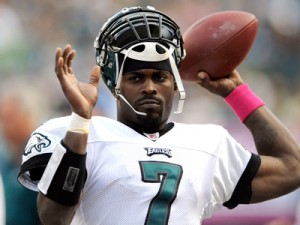 Before I continue, it’s important I disclose to you that I hate Michael Vick as much as you can hate someone you’ve never met.
 But Vick’s actions aren’t simple. They require analysis way above my pay grade. It’s not as easy as evoking “they’re just dogs.” 99% of those who’ve uttered “they’re just dogs” would not stand by and allow something like dog-baiting to occur in their presence. Vick didn’t simply participate in dogfighting. He led and financed an interstate crime syndicate, and he hosted it on his own property. He hung and drowned dogs who “underperformed.” It’s not an issue of culture—that defense is as racist as it is ridiculous. It’s not an issue of mankind’s dominion over animals. It’s a question about the very value of life. I truly believe that Vick’s lack of respect for life extends to humans. I truly believe that Vick will be forever incapable of understanding the gravity of his actions.
 Just a few days ago, Nike signed Vick to an endorsement deal four years after they severed ties with him. Forgive and forget? Nike weighed the pros and the cons and they came to the conclusion that it makes business sense to have Vick out there on their behalf. Nike is banking on the fact that those of us who buy their products have forgiven by now (or don’t care). Nike can take the hit from those who, like me, will never buy another Nike product.
 I don’t think anyone has forgotten, though. Vick’s name will be forever synonymous with dogfighting. In the end, it seems that forgiving is more important and easier than forgetting. Forgiving is especially easy when it accompanies winning. Winning is very powerful force. Kobe Bryant has been forgiven since his rape charges in 2003. The eight years have helped, but the Lakers’ two championships really helped. Ray Lewis led the Ravens to a win in Super Bowl XXXV and was named its MVP. This was a year after his involvement (to whatever extent) in the stabbing deaths of two people. His past transgressions might even be forgotten at this point. When we talk about Lewis now, we talk about his place in the pantheon of football players, not his past.
 It has been said that he paid his “debt to society.” I’m not sure what that means. But obviously many people do. If he continues to play as he did in the 2010 season, if by some miracle the Eagles win a Super Bowl, the percentage of people who forgive will increase. That’s how it works, for better or for worse.
 9. Portland Trail Blazers: 1970/71 – 1989/90 (NBA)
 8. Minnesota North Stars: 1967/68 – 1973/74 (NHL)
 7. Toronto Blue Jays: 1977 – 1996 (MLB)
  6. Pittsburgh Steelers: 1963 – present (NFL)
 5. California Golden Seals: 1970/71 – 1973/74 (NHL)
 4. Milwaukee Brewers: 1978 – 1993 (MLB)
 3. Montreal Expos: 1969 – 1991 (MLB)
 2. Hartford Whalers: 1979/80 – 1991/92 (NHL)
 1. Vancouver Canucks: 1970/71 – 1979/1980 (NHL)