
It’s ten past five o’clock in the evening of July 17th, 2011. The bar is completely silent except for one voice… My own. In New York City—the one place in the U.S. with a sizable contingency of faithful soccer followers—and I’m the only one cheering for Japan over the red, white and blue in the Women’s World Cup Final. The “short little ladies,” as the Japanese coach called them, of the Nadeshiko Japan has just pulled off one of the greatest upsets in the history of sports.
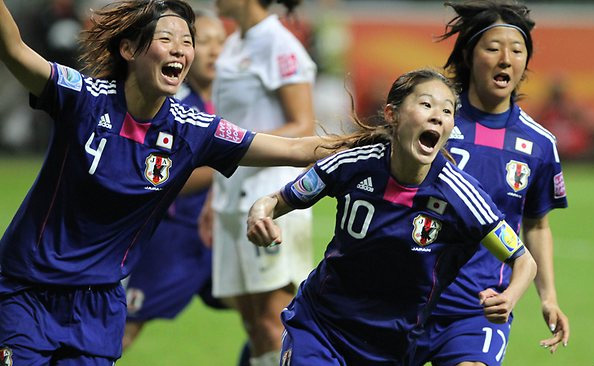 Going into the game, the sentimental value on Japan’s part was well publicized and documented due to the tragedy of the March 11th earthquake and tsunami and the subsequent nuclear disaster in northern Japan. Many of those affected by the calamity are still living in shelters, and in a nation like Japan with its homogeneous society, the tragedy has truly united the country. Men and women. Young and old. Soccer fans and baseball fans. For this reason, and not because they were such heavy underdogs, Japan was easily the sentimental favorite for anyone outside of the U.S.
There was no doubt that the U.S. played better overall and should have won the game. The first thirty minutes put supporters of the Japanese in constant fits of agony. Every five minutes, it seemed like the U.S. was on a break, threatening the Japanese goalie, only to see the ball somehow go wide or hit the post. The more the U.S. threatened, the more Japan escaped without conceding a goal, the more I began to wonder if I was about to witness one of those magical sports moments. Even when the U.S. went ahead 1-0, then 2-1, I had a feeling Japan was somehow going to come back. It was one of those inexplicable moments where the weight of a catastrophic tragedy propels the game to a whole new level of drama, inspiration and magic. In such moments of pure emotion and adrenaline, better talent and performance doesn’t always equate to victory. And when element of perseverance in the face of tragedy is associated with the underdog team, the story often seems to end in a fairytale fashion: A perfect upset. Japan, while clearly being dominated for much of the game, scored their first goal off a lucky bounce that resulted from a clearing miss by the usually reliable Ali Krieger. Their second goal came off a corner kick where Homare Sawa somehow, almost magically flicked the ball off the right side of her foot from a spot where math would deny her an appropriate angle. Two unbelievably fortuitous goals that were in stark contrast to the beautifully crafted goals by Alex Morgan and Abby Wombach. How did this happen? While religion lies low on my mind, do I dare call it divine intervention? There’s just no other way to explain how Japan won a game where they didn’t have possession, typically their area of strength, were outclassed at almost every position and went up against Hope Solo in penalty kicks with a very shaky goalkeeper on their side. Studio heads take note: Hollywood couldn’t have scripted this any better.
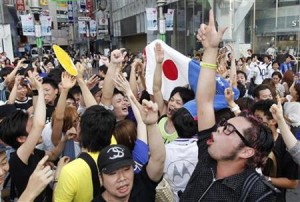 Whether it was sheer luck or divine intervention, it was yet another reminder of the power of sports and its healing power. It didn’t matter that I wasn’t directly affected by the tragedy in Japan. But knowing that my own father, who never sacrifices sleep in order to catch a game on television, woke up at 3:30am Japan time on a Monday to watch this game, I know how much this game meant to him, how much this game inspired him and how much he wanted to be inspired by this game. There is no doubt there were more cheers and tears at dawn across the country on Monday than any other moment in its sports history. Consider what the Saints winning the Super Bowl meant for New Orleans, even five years after Katrina. Now, make that an entire nation and only four months after a tragedy of much bigger magnitude. The degree to which this victory has both inspired and healed the country cannot be stated in mere words.
Finally, I leave you with the meaning of Nadeshiko, the nickname of the Japanese women’s team: While the literal translation is “pink dianthus flower,” which is known to be very tough and resilient, the term-in-use actually comes from the phrase Yamato Nadeshiko, which signifies “ideal Japanese women with grace and beauty.” Japan not only won the World Cup, but also received the FIFA Fair Play Award, a recognition fitting for Nadeshiko, especially for their graceful, technical style of play. Even an average Japanese soccer fan can’t even name more than a few players on this team, much less know that there’s a women’s league in Japan. But these previously unknown “short little ladies” of Japan are now standing taller than ever, and for many days, months and years to come, will forever be revered as heroes in the Land of the Rising Sun.
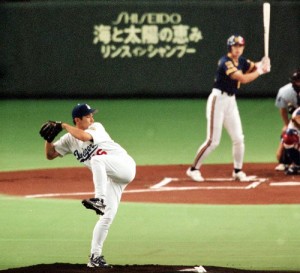
 Nomo Mania began in the 1995 season, when he splashed onto the Major League scene with the Los Angeles Dodgers, seemingly out of nowhere, after a bitter contract dispute with the Kintetsu Buffaloes of the Pacific League in Japan. Mesmerizing crowds and bewildering opposing batters at every ballpark with his never-before-seen “tornado” windup style, he finished the season with an impressive résumé, leading the league in strikeouts, a 13-6 record and a 2.54 ERA. And let’s not forget he was the starting pitcher for the National League in the All-Star Game. His performance was even more impressive the following season, going 16-11 and capping the year off with a no-hitter at Denver’s Coors Field, the hitter’s paradise. All these numbers, however, don’t begin to tell the story of Nomo, whose legacy, while paling in comparison to that of Jackie Robinson, warrants a discussion as a future Hall of Fame member for his contributions to the game of baseball as a whole.
 While we can’t give Nomo all the credit for the globalization of baseball in the last decade, the success that he enjoyed encouraged 42 other Japanese players to successfully make their way to the Majors since then. This alone speaks volumes. Sure, Ichiro might have ended up playing in the Majors anyway, but perhaps not as early as 2001. And Nomo’s success certainly influenced general managers across the MLB to look outside of the U.S. to not only Japan, but other Asian countries as well. The infusion of Latin and Asian players into the Majors in the last 15 years, along with the additional revenue the MLB has generated with its globalization initiatives, must, at least in part, be credited to him.